



6 May 2026

The economy: Stagnation until 2028?

Date

6 May 2026

share

Stefán Ólafsson writes:

The Central Bank is cooling the economy, hoping to bring down inflation. It does this by keeping interest rates high, which bites into indebted households and companies.


It does not, however, work on foreign price increases, nor on inflation due to rising housing costs, nor on the demand expansion of indebted and high‑income individuals and companies, nor on the expansion due to private consumption of a large number of tourists. These measures of the Central Bank have ultimately proven to deliver only limited results and are, moreover, exceptionally unfair in the distribution of burdens.


But the Central Bank's method certainly cools the economy, it almost reduces economic growth and increases unemployment. That is the cost of applying the high‑interest rate policy.


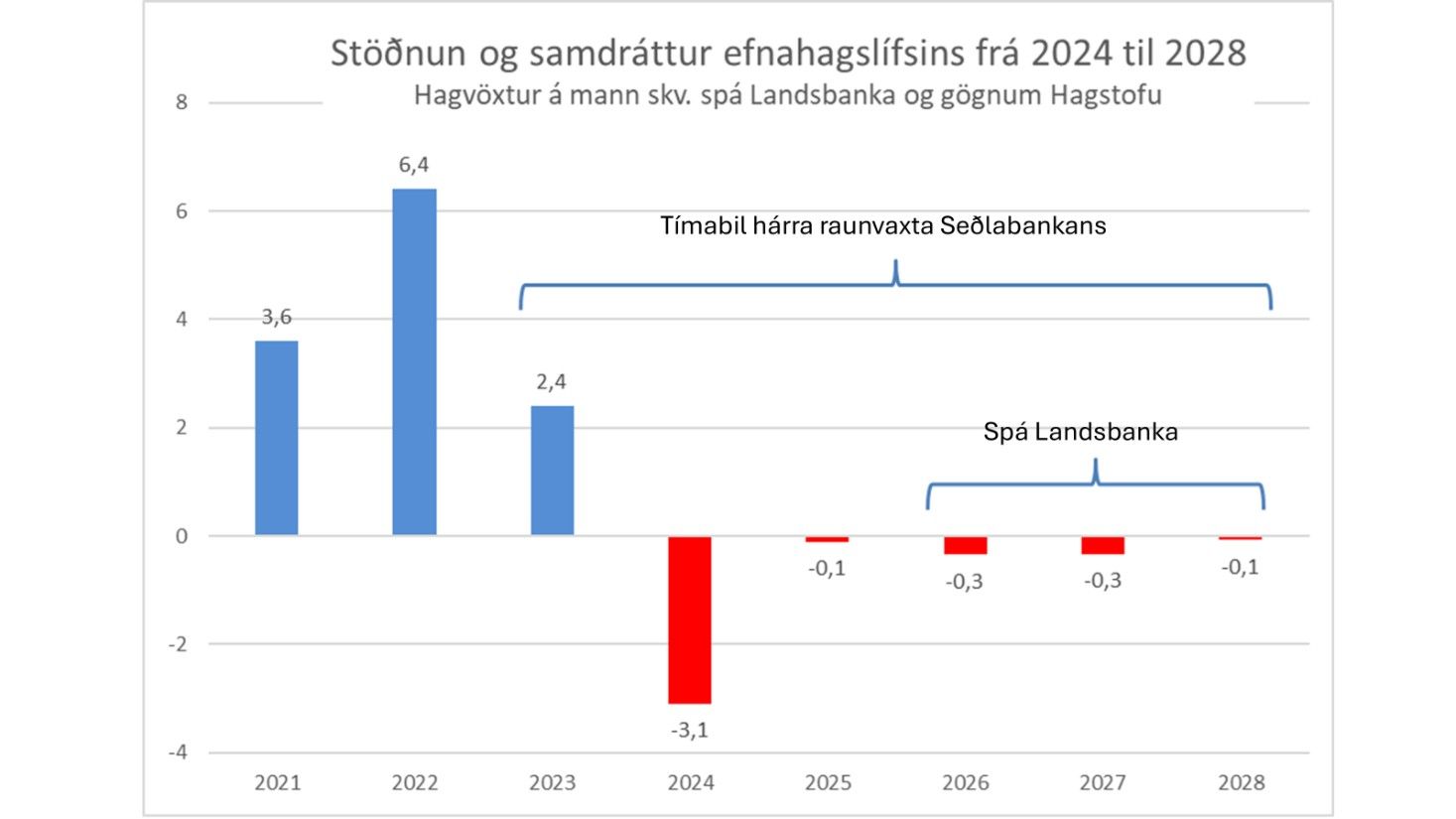
Recently the analysis department of Landsbanki Iceland published its economic forecast for the years 2026 to 2028, which assumes economic growth of only 1.6 to 1.8% over the next three years. This is lower than the projected population growth in the country, according to the Statistics Iceland forecast. Growth per capita will therefore be negative.


This essentially means that the economy has entered a stagnation that is expected to continue at least until 2028. This can be seen in the image below, which shows GDP per capita.

There are misleading reports, which hopefully will not be resolved. But this is the cost of applying this measure of the Central Bank that we are facing. And that without any good result having been achieved in lowering inflation and ensuring stability. This is clearly a path that does not pay off.


Ég hef í mörgum greinum á síðustu mánuðum lagt til að ríkisstjórnin grípi til beinna aðgerða gegn verðbólgunni, í anda hagstjórnarstefnu Keynes lávarðar. Það er hægt að gera með beinum og öflugum inngripum í húsnæðismarkað, fjármálamarkað og víðar, og með markvissri beitingu fjármálastefnu og skatta til að tempra eftirspurnarþrýsting þeirra sem raunverulega spenna upp verðbólguna (sjá t.d. „Verðbólgan: Betri leið er í boði“). Sjá einnig ítarlegar tillögur Efling um leigubremsu, sem eru vel til þess fallnar að slá hratt á verðbólguna.


The government, which is facing stagnation in the economy for three years in addition to the two that have already been lost, is not in a good position. Unchanged, the entire term of Prime Minister Kristrún Frostadóttir's government will be a period of stagnation, if the Landsbanki forecast holds. Delivering a balanced budget next year will not contribute much to lowering inflation. Much more is needed in terms of other kinds of measures.


If the government were to achieve good results in increasing per‑capita growth with a newly‑crafted employment policy, then the Central Bank would come back and say that too much optimism and demand‑pull inflation would enter the economy – which would call again for higher interest rates and greater cooling. The brakes would need to be applied. This is the bottleneck we are in, by locking the economy into the Central Bank's high‑growth policy.


I hope that the government has sufficient self‑rescue initiative to move away from the market's trade‑liberalisation policy and to rely less on the Central Bank's high‑interest‑rate policy in the near future. We need to be able to achieve economic growth without the Central Bank stepping on the brakes. That calls for all measures other than a high‑interest‑rate policy and a flat budget.

The time has come for fundamental changes in economic policy, if we are to avert the impending stagnation of the Icelandic economy by 2028.


Stefán Ólafsson is a professor emeritus at HÍ and works as an expert hjá Efling.
The article was first published in the source on 4 May 2026.


By Freyr Efling 27. May 2026
Office Efling union opens later than usual on the upcoming Friday, May 29, due to a staff meeting. The office opens at 10:00 that day instead of 9:00 as usual.

By Freyr Efling 27. May 2026
Efling union draws the attention of its members to the fact that, according to most collective agreements, employers must pay holiday allowance on 1 June of the coming year in addition to regular wages. Members are therefore urged to give special attention to whether that payment does not reliably appear in the next payroll, by reviewing their payslip at their own expense. If there is any doubt that the holiday allowance has been paid correctly or other questions arise, members are advised to contact the union representatives at their workplaces, or the union itself. The holiday allowance is a fixed amount and holiday days are not calculated on top of it. The allowance is paid proportionally to the work ratio and working time. The holiday allowance must be settled before the end of employment. Here you can find calculator Efling for holiday allowance. With it, members can calculate their holiday allowance in a simple and quick way. The calculator can be adjusted according to different collective agreements, including agreements for the general labor market (SA), hotels and restaurants, the City of Reykjavík, the state, other municipalities as well as nursing homes (SFV). The amount is calculated based on the holiday year 2026, which runs from 1 May 2025 to 30 April 2026.
By Freyr Efling 20. May 2026
Board Efling of the union has decided to fund Matthildi, an organization for harm reduction, with 1.7 million kronur. The Matthildi organization was founded in 2022 and focuses on harm‑reduction services at the early stages of substance abuse. The aim of harm reduction is to help people stay alive, protect their health, both physical and mental, and to empower them in all small steps towards positive change. Matthildi runs the harm‑reduction service Reyk. The service is free of charge for everyone and places a special emphasis on reaching people at the early stages of substance abuse, with the aim of preventing a more serious development of the problem and untimely deaths. In the period from 4 February 2025 to 31 January 2026, Reyk has provided service to 235 individuals on 1,100 occasions. Of these, 25 percent of the clients are employed, and some of them are members of Efling. These individuals struggle with substance abuse as well as poverty and difficult social circumstances. A steady increase in opioid problems has occurred over the past nearly fifteen years. In addition, problems related to cocaine use, crack and methamphetamine smoking have risen steadily over the last decade. It is very important to provide the group facing this problem with harm‑reduction services and support for recovery. The Reyk service is for many the first point of contact for assistance and provides clients with extensive support, follow‑up and connection to social and health services. Matthildi has assisted many in substance‑use treatment, opioid medication treatment and obtaining appropriate social services. In doing so, the organization has helped individuals recover and be able to keep housing, mental health and continue working.

Show more news